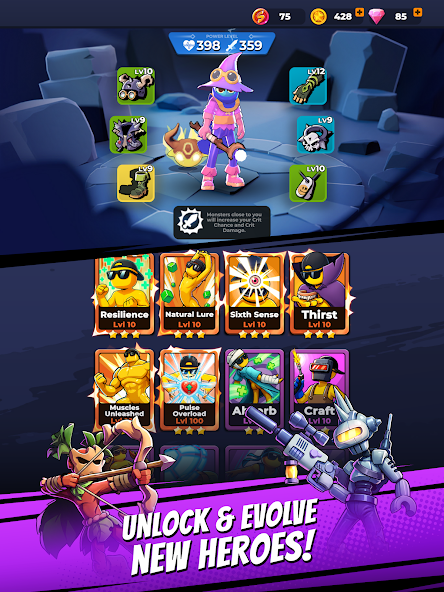
First 30 minutes
A Beginner Route You Can Follow Immediately
The exact unlock timing varies by account and App version. Use these checkpoints as a decision route, not as a promise that a specific menu or reward appears at an exact minute.
Learn the Main Run
- Use the strongest developed hero currently available.
- Take reliable coverage before chasing a specialist roll.
- Favor Damage and Attack Speed when both choices are useful.
- Notice whether crowds, a boss, terrain or repeated hits end the run.
Complete Three Weapon Jobs
- Secure one crowd-clear option.
- Add one close or focused-damage option.
- Keep one developed flex weapon rather than another duplicate role.
- Deepen useful weapons instead of collecting every offered card.
Make the First Account Spend
- Buy broad permanent Damage or Attack Speed value.
- Keep new gear shallow unless the effect is clearly useful.
- Save Gilded Cores when the full result is not obvious.
- Repeat the failed route and test one change at a time.
Quick answer
The Safest New-Account Route
Do not try to upgrade everything you unlock. Choose one developed hero, build three clear weapon jobs around that hero, buy broad permanent power and change only the part that caused the last failure.
Choose One Main Hero
Use the strongest developed general hero currently available. Do not restart account investment around a fresh unlock unless its visible abilities and available support create a better complete setup.
Build Three Weapon Jobs
Take one crowd option, one close or focused option and one reliable flex weapon. Avoid filling every slot with weapons that solve the same problem.
Strengthen the Main Plan
Damage and Attack Speed offer broad value. Add Range, Speed, Crit or durability only when the map or failure point makes that stat necessary.
Spend Outside the Run Carefully
Buy permanent upgrades that help many runs, protect Gilded Cores and enhance gear that supports the same build instead of several temporary pieces.
Read the Failure
Crowded out, boss survived, trapped by terrain and dying to repeated hits are four different problems. Each needs a different adjustment.
Farm Only When It Is Safe
XP Gain, Pickup Range and Luck are useful on repeatable content. During a hard push, they should not replace the damage or survival needed to clear the gate.
Decision guide
Your First Important Choices
Use this table when the game offers several attractive directions at once. The goal is account consistency, not collecting the largest number of unfinished options.
| Decision | Choose This First | Wait When | Beginner Reason |
|---|---|---|---|
| Hero investment | Your strongest developed general hero | The new hero has no supporting upgrades or gear | One usable hero advances faster than several incomplete ones. |
| Weapon upgrade | A developed weapon that fills a missing role | The weapon duplicates coverage already in the loadout | Current level and rank can matter more than a theoretical tier. |
| Permanent stat | Broad Damage and Attack Speed value | A narrow stat does not fix the current wall | Broad power improves more heroes, weapons and maps. |
| Gear enhancement | A keeper item with useful current stats | You would consume the only good alternate item | Temporary gear drains materials without creating a stable build. |
| Gilded Cores | Broad long-term value or a direct wall fix | The benefit is cosmetic, narrow or unclear | Scarce currency should create a visible account improvement. |
| Economy stats | Safe repeatable maps | A boss or wave already blocks progress | More resources do not help if the run cannot reach its reward safely. |
Starter build framework
Give Every Weapon a Different Job
A good beginner loadout is balanced enough to survive unknown maps. It does not require one exact weapon roll; it requires coverage for the problems that normally end a run.
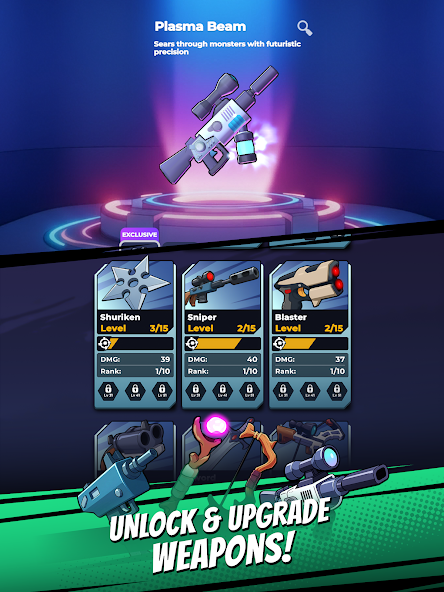
Plasma Beam or Chain Lightning
Use coverage to stop normal enemies from closing every safe route.
Shotgun or Sniper
Shotgun helps when enemies reach you; Sniper becomes more useful when focused boss damage is missing.
Pistol or a Better-Developed Alternative
Keep a dependable weapon unless another card has a clear rank advantage and fills the same job.
During a run
How to Choose the Next Upgrade
1. Complete the Role
If enemies surround you, improve coverage before adding another specialist. If the boss survives, add focused damage without removing all crowd control.
2. Deepen Strong Weapons
A developed main weapon usually creates more immediate value than collecting several low-investment weapons with overlapping jobs.
3. Fix One Weakness
Use Speed and Range for positioning, Crit for focused damage, or HP, Dodge, Armor and Shield when survival is the actual failure.
Do not take a stat just because it is generally good
An upgrade is useful only if it strengthens the current build or solves the next threat. A farming stat during a hard boss attempt can be worse than a lower-ranked damage or survival choice.
Outside the run
Three Stages of Beginner Progression
Build Consistency
- Keep one main hero.
- Develop one balanced weapon package.
- Buy broad permanent power.
- Save rare materials until the result is clear.
Fix the Failure
- Name the exact enemy, wave or boss problem.
- Change one weapon role or one stat layer.
- Upgrade keeper gear that supports the fix.
- Test before replacing developed account pieces.
Grow Resources
- Repeat content the build clears reliably.
- Add XP Gain, Pickup Range or Luck.
- Keep the main damage engine intact.
- Return to a push build at the next gate.
Resource protection
What Not to Spend Too Early
Gilded Cores
Spend when the result has broad permanent value or directly removes a progression wall. Do not use scarce Cores simply because an upgrade is available.
Check Core rewards and spending →Keeper Gear
Compare current stats and the preview before enhancing, merging or consuming useful pieces. Build one functional equipment direction before chasing several sets.
Choose keeper gear safely →Hero Resources
A fresh hero is not automatically stronger than the developed hero already carrying the account. Switch only when the new card and available support create a better full setup.
Weapon Materials
Prioritize weapons that fit the main loadout. Splitting levels across every unlock can leave the account with no strong answer for crowds or bosses.
Troubleshooting flow
Why Did the Run End?
| What You See | Likely Missing Layer | Try First | Avoid |
|---|---|---|---|
| Normal enemies close every route | CROWD COVERAGE | Plasma Beam, Chain Lightning, Attack Speed or Range | Adding another narrow boss weapon |
| Waves feel easy but the boss survives | FOCUSED DAMAGE | Sniper, Shotgun, Crit or more Damage | Removing every crowd-control slot |
| Obstacles or projectiles trap you | POSITIONING | Speed, Range, Dodge and a safer route | Standing still to force damage |
| A few mistakes create a death chain | DURABILITY | Max HP, HP Restore, Armor, Shield or Dodge | Replacing all damage with defense |
| The whole run falls behind gradually | ACCOUNT POWER | Broad permanent upgrades and a more developed main weapon | Starting a second incomplete build |
| The farming setup cannot clear safely | TOO MUCH ECONOMY | Remove XP, Pickup or Luck until damage is stable | Adding more economy to compensate |
Before the next push
Beginner Readiness Checklist
- One main hero receives most account investment.
- The loadout has crowd and focused damage.
- Each weapon has a different job.
- Gear supports the same build direction.
- Permanent spending improves many runs.
- Gilded Cores have a defined purpose.
- Economy stats are reserved for safe content.
- The last failure has a named cause.
FAQ
Monster Survivors App Beginner Questions
What should I do in the first 30 minutes?
Use the strongest developed hero available, complete crowd, focused or close, and flexible weapon roles, then buy broad Damage or Attack Speed value. Keep gear investment shallow and save Gilded Cores until the complete result is clear.
What should I upgrade first?
Start with broad permanent Damage and Attack Speed value, then add survival only when taking damage ends the run. Keep one main hero and weapon package ahead of secondary options.
What is a good beginner weapon setup?
Use Plasma Beam or Chain Lightning for crowds, Shotgun or Sniper for close or focused damage, and Pistol or a higher-developed alternative as the reliable flex slot.
Should I spend Gilded Cores immediately?
No. Spend when the upgrade provides broad long-term value or directly fixes a progression wall. Read the current result before confirming a scarce-resource purchase.
Why did my strong build suddenly stop working?
The new map may demand a different layer: coverage for dense waves, focused damage for a boss, movement for obstacles and projectiles, or durability for repeated hits. Change the failed layer instead of rebuilding everything.
Is this the same as the online browser game?
No. This guide covers the VOODOO App. The site's Play Online version has a separate roster, weapon system, maps and progression loop.
Next steps
Turn the Route Into a Stronger Account
Use the detailed pages only when their decision becomes relevant.
Starting Weapons
Choose the first weapon worth developing.
Best Builds
Match hero, weapons, gear, skills and map type.
Best Weapons
Compare crowd, boss, close and flex roles.
App Upgrades
Plan permanent power, Gilded Cores and gear.
App Tier List
Compare builds, weapons, hero profiles and stats.
App Wiki
Find the right guide for each unlocked system.